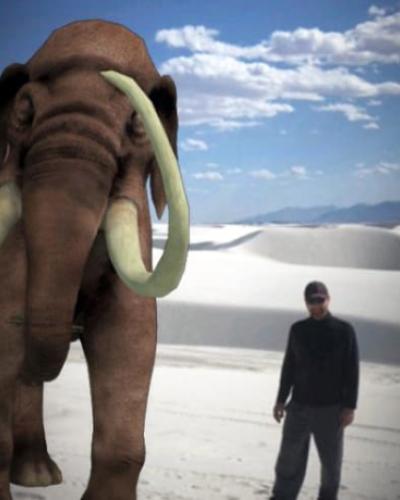
Over the past year, Cornell archaeological scientists have played a central role in a collaboration with the U.S. National Park Service to document foot prints from extinct Pleistocene megafauna including humans, at White Sands National Monument in New Mexico. The foot prints which number in the thousands, are often referred to as “ghost tracks” because they are only visible under certain moisture conditions. Cornell’s role was in developing methods using geophysics to detect the tracks when they are not visible, and to document them in the field without harming the fragile surface. This work was carried out by Thomas Urban, Visiting Scholar with the Cornell Department of Classics and the Cornell Tree Ring Laboratory, as part of a collaborative project in which Cornell is a partner. The first of several developments stemming from this work was recently published in Science Advances with Urban as a co-author: http://advances.sciencemag.org/content/4/4/eaar7621.full
New Faculty: Camille Louis
A&S Communications